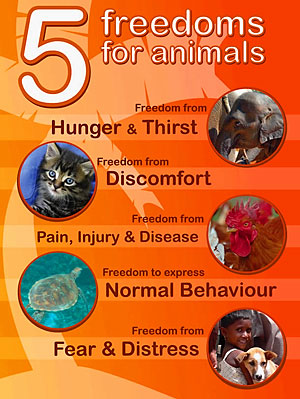
The five freedoms was initially suggested by Professor Roger Bramwell after the government asked him in 1965 to conduct an investigation into the welfare of intensively farmed animals. From this investigation Bramwell reported that animals should have certain rights if kept under human care- these are known as Bramwell's five freedoms and are aspirations for ideal animal welfare.
Bramwell's Five Freedoms
1. Freedom from hunger and thirst - this can be achieved by ensuring water is avaliable at all times and animals are provided with the correct nutrition regularly.
2. Freedom from discomfort - by allowing animals to rest, provding them with shelter
3. Freedom from pain, injury or disease -by providng a rapid diagnoses and treatment of a condition or disease as well as taking preventative precautions.
4. Freedom to express normal behaviour - provding suitably sized areas for livestock to graze, hygenic and safe facilities, company of the animals own kind
5. Freedom from fear and distress - ensure conditions and routines do not cause the animal any stress
From this report being published, the Farm Animal Welfare Advisory Committee were formed to monitor how the livestock farmers would respond to these new guidelines. The RSPCA also have adopted the five freedoms as their basis for animal welfare rules.
The five freedoms are also now included under the Animal Welfare Act 2006, and if you are a pet owner it is your responsibility by law to meet these whilst the animal is under your care. Failure to could cause fines of up to £20,000 a minimum sentence of 51 weeks in prison and a lifetime ban on keeping animals.
If all owners of animals followed these five simple rules a good standard of animal welfare could be achieved leading to a healthy, happy lifestyle for those animals in our care.

No comments:
Post a Comment